
 October
30
October
30
Tags
A New Scapegoat: Acetaminophen and ASD
Communication is crucial on any scale – between friends or coworkers, and between the government and its constituents. While keeping your loved ones informed may be a challenge in itself, keeping Americans informed on progress in scientific research is a wholly different issue. Over the last several years, doubt has been sown between scientists and the general public. While we have previously highlighted the importance of science communication (examples from our catalog can be found here and here), a lot has occurred in the past several weeks that have underscored the growing issue of miscommunication between scientists, governing officials, and citizens.
The Current Situation
Most recently, there has been a lot of concern over the safety of acetaminophen, commonly sold under the brand Tylenol. The Trump administration put out an abrupt statement, declaring a definitive link between Tylenol exposure during fetal development and development of neurodevelopmental disorders including autism spectrum disorders (ASD) [1]. Among many other important messages which I hope to convey in this article, there is one core belief that must be shared – many folks with ASD believe that it is not a disease that needs to be cured, but for many parents whose child has more moderate or severe symptoms, there is a strong hope scientific research will uncover treatments that alleviate these symptoms [2]. ASD is a neurodevelopmental disorder that affects a child’s social communication, language development and cognitive abilities, to varying degrees across children. Children and adults with ASD deserve the same respect and treatment as anyone else. Today, there are many who find resources online celebrating autistic folks, providing guides for how to navigate a variety of resources that range from helpful to harmful (see this page for one example). ASD research aims to discover causes and treatments for social, sensory, and communication symptoms in people with ASD. It is important to know that ASD is highly heritable, with estimates as high as 90% [3]. Yet, what is inherited that predisposes to or leads to ASD symptoms is unknown for almost all cases. In fact, an estimated 91% of ASD individuals are considered idiopathic, which means that we do not know why the condition developed [4].
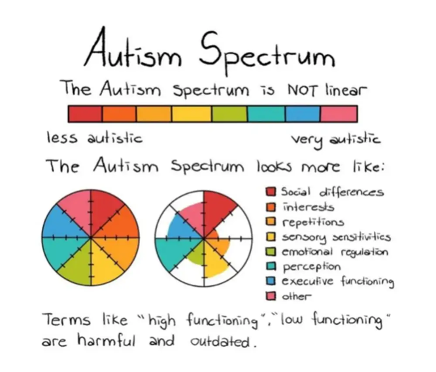
Researching the origins of ASD is as complicated and varied as the spectrum itself. Some autistic individuals with mild symptomology live incredibly normal lives, while others with more moderate or severe symptomology have greater support needs [5]. A small percentage of children eventually earn college degrees, while others are profoundly affected, requiring lifelong, around-the-clock care. For a small handful of individuals with “syndromic” ASD-like features, specific genetic mutations have been found, but these known syndromes are extremely rare. For instance, Phelan-McDermid occurs in an estimated 1 in 20,000 to 1 in a million, and most do not have cardinal ASD social symptoms; Rett syndrome occurs in 1 in 20,000 and symptoms and brain growth characteristics in most cases are strikingly different from ASD [6,7]. Knowledge of these rare syndromes have not advanced our understanding of idiopathic autism. Understandably, this can be very difficult to grapple with. As investigative humans, it is extremely difficult to cope with a challenging situation which does not yet have an answer or explanation – and this has led to the ongoing search by families and researchers alike to identify environmental changes that may underlie shifts in development. Unfortunately, this has also led researchers to take advantage of vulnerable people searching for answers.
An Uphill Battle
For decades, the field of ASD research has been tarnished by a now-retracted 1998 study published by now-discredited fraudster and disgraced doctor Andrew Wakefield. This study claimed to have identified a relationship between the measles mumps and rubella (MMR) vaccine and ASD (Lancet 1998; 351[9103]:637–41). When a study is retracted, this means that it has been removed as a formal publication due to an error or larger issue with the work within the publication. In this case, the paper was retracted for several reasons.
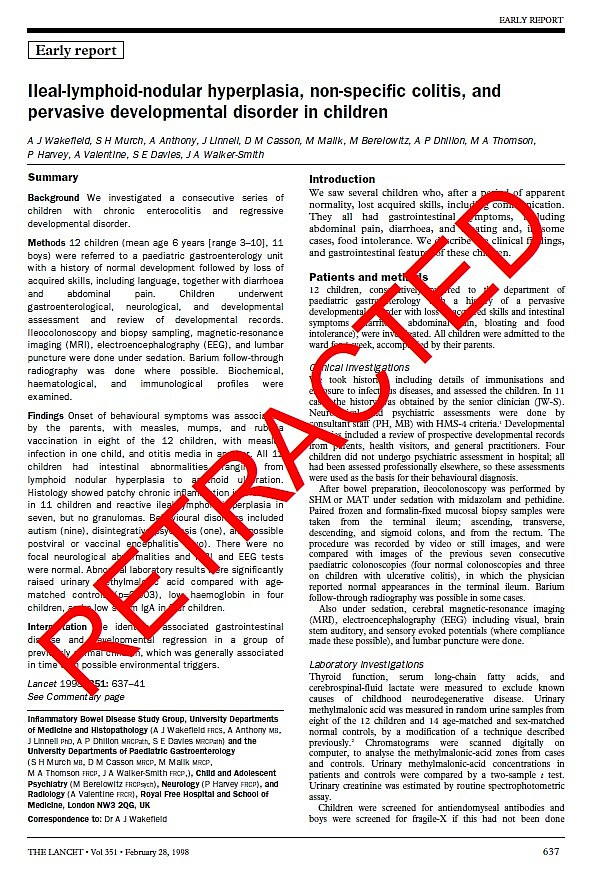
- Conflict of interest: Wakefield was recruited by a lawyer who hired him to act as an expert witness about “vaccine damage” [8]. This financial stake incentivized him to gather evidence further connecting vaccines to negative outcomes, precluding him from entering any study on the matter with an unbiased outlook.
- No IRB approval: A crucial part of conducting research in a clinical setting intended to ensure safe and ethical conduct with informed consent from patients [9]. Wakefield’s study lacked this approval.
- Biased recruitment and data manipulation: The 1998 study was made up of children who were selectively sought to join the “study,” because their inclusion would support Wakefield’s preconceived theory of a link between the MMR vaccine, gastrointestinal issues, and ASD. Remarkably, Wakefield even falsified some children’s medical records to fit his asserted timeline [10].
Despite this paper being the genesis for many anti-vaccination theories based on the alleged association of the MMR vaccine with ASD, this was not even Wakefield’s original message. He did not advocate for ceasing vaccinations, rather, he proposed a restructuring of the medical standard. In press conferences, he theorized that the MMR vaccine may be an environment trigger for development of ASD because it was a combination vaccine designed to prevent multiple ailments. He assessed this combination vaccine as a unique issue due to its difference from traditional single vaccines, and spoke in favor of single vaccinations, and he had quietly patented his own single vaccination approach to replace the MMR [8, 10]. So, as you can see, the message has become exaggerated and twisted even from the original message – which, in itself, was not founded on well-controlled research. It is absolutely crucial to note that multiple subsequent studies were unable to replicate the findings of Wakefied’s retracted paper [11].
Despite the huge amount of federal and private funding which has paid for ethical, well-controlled research to debunk this retracted finding (cited as costing tens, if not hundreds, of millions of dollars as early as 2010 [12]), initial doubt sown by Wakefield’s paper has created a narrative that many well-meaning people looking for explanations have clung to. Regrettably, it has also created a narrative that has allowed those with mal intent to push their anti-vaccination agendas, in ways that have fear-mongered dangerously and led to resurgences of life-threatening diseases that were previously under control and nearly eradicated [13]. This instillation of fear has recently expanded to the use of the drug acetaminophen during pregnancy and early childhood. A meta-analysis (an analysis of multiple pools of pre-existing data from various sources) serves as the source of the new theory, but it is currently just that – a theory. It is not proven, despite the White House claiming that there is a definitive causal link between acetaminophen exposure during development and ASD. Before we dive into the claims, let’s examine the subject of this panic – Tylenol.
A Brief History of Tylenol
Although it may seem like a piece of relatively modern medicine due to its regular and consistent use in today’s world, acetaminophen was actually synthesized in 1878, and the brand name drug Tylenol became commercially available much later, in the 1950s [14, 15]. Interestingly, it was initially marketed as a pain and fever reducer specifically for children, due to its potential as an alternative to aspirin [14]. For decades, it has acted as such and is generally viewed as a gentler painkiller than many alternatives.
Acetaminophen, like many common drugs, works in a manner that is not 100% understood. Though scientists have tried for decades, we have only a compelling theory for its mechanism of action. It is believed that acetaminophen relieves pain and fever by blocking the transmission of cyclooxygenase (COX) enzymes, which play a role in the body’s inflammatory response [16]. These enzymes, particularly COX-2, promote the release of prostaglandins, which are necessary for pain signaling [17]. By quieting down this process, the sensation of pain is alleviated. This is extremely similar to a class of painkillers called NSAIDs (non-steroidal anti-inflammatory drugs, including aspirin, ibuprofen, and others), but acetaminophen’s effects are restricted to the central nervous system – the brain and spinal cord – while NSAIDs act throughout the entire body [18].
Interpretation of Data

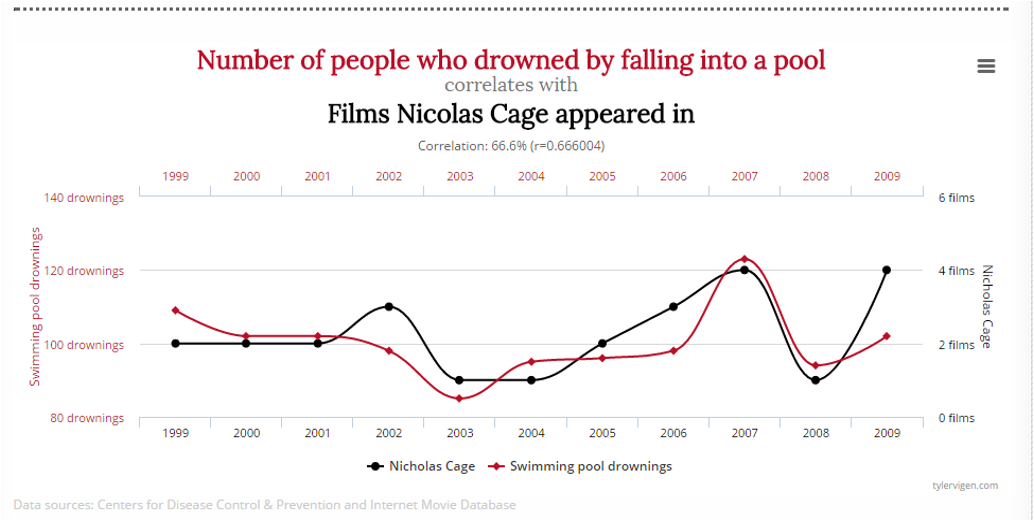
Before delving further into the relationship detected between acetaminophen and ASD, it is useful to review methods of assessing relationships between variables in a scientific context. One of the lessons training scientists learn in statistics classes is the mantra, “correlation does not equal causation.” This describes the fact that simply because two variables are correlated, i.e., they may occur in tandem with a seemingly inextricable relationship, that does not mean that one variable has caused the other. A classic example is the increase of ice cream sales in the summer (variable A) and the increase in shark attacks (variable B). What this relationship fails to account for is an unnamed variable – summertime (variable C). In the summertime, one might purchase an ice cream more frequently to cool down when compared to purchasing behavior in the winter. Similarly, people will flock to the ocean on hot summer days, increasing their chances for a run-in with a shark when compared to days spent indoors or away from the ocean. If variable C was not accounted for, one might find their local ice cream shop plastered with signage depicting harrowing warnings like the one depicted in Figure 1. There are many unrelated topics that also trend together just by chance, not even due to an obvious third variable underlying A and B; for an example of this phenomenon, please refer to Figure 2.
Overlooking Variables
There is danger in misinterpreting and exaggerating data far beyond missing out on ice cream in the summer for fear of sharks. While the president may have stated that if one doesn’t take acetaminophen, “Nothing bad can happen. It can only good happen. But with Tylenol, don’t take it” [19] – yes, that is the accurate quote – he is not telling the full story here. What the statement fails to acknowledge is the danger of fever and maternal immune activation during pregnancy.
We will begin by looking into this topic – the issue of maternal immune activation. One of the relatively widely studied environmental factors that has been associated with neurodevelopmental disorders is illness of a pregnant mother, resulting in an immune system that is too highly active during pregnancy. This can be thought of as a variable C – an additional variable that is not accounted for in the current proposed model of variable A (Tylenol exposure) leading to variable B (the outcome of ASD). Even though this area of research has been extensively studied, researchers are very upfront with the fact that there are confounding variables in the study of human development that make it very difficult to parse the effects of immune system hyperactivity and inflammation during pregnancy from genetic and familial factors [3]. It is studied in a more well-controlled manner in preclinical mouse models in a lab, but these studies must be developed further before their findings can be extrapolated to human development [20]. The White House statement cites scientific literature which has been peer-reviewed and published, which is typically the gold-standard. However, the issue lies in how the data is being interpreted and communicated. In reference to one citation, they conclude it “report[s] associations between in utero exposure and later diagnoses of autism spectrum disorder (ASD) and attention-deficit/hyperactivity disorder (ADHD)” [1, 21, 22]. But, that is all it is – an association – not a definitive cause. Unfortunately, this also holds true for claims about single gene variants that appear to underlie ASD – they are also associational. The majority of these single gene mutations are not inherited, and do not explain the high rate of ASD heritability. Indeed, harboring healthy skepticism for one corner of ASD research requires doing the same for the other. From the Boston Birth Cohort study, the researcher’s bottom line is exactly this – their findings “warrant additional investigations” [22]. The words of the authors who analyzed the data hold much more weight than interpretations by politicians with no scientific or medical training.
The FDA promptly released a statement following the White House press conference which instigated this discussion. The following quote is an excerpt from their news release: “It is important to note that while an association between acetaminophen and neurological conditions has been described in many studies, a causal relationship has not been established and there are contrary studies in the scientific literature. It is also noted that acetaminophen is the only over-the-counter drug approved for use to treat fevers during pregnancy, and high fevers in pregnant women can pose a risk to their children. Additionally, aspirin and ibuprofen have well-documented adverse impacts on the fetus” [23].
This statement is quick to acknowledge the conflicting data put forth in the cited meta-analyses, not just the subset which supported the White House’s claims. Additionally, they refer to the dangers of fever in pregnant moms, as well as the fact that acetaminophen is the only painkiller without adverse risks during pregnancy. This hearkens back to the mechanisms we discussed earlier; NSAIDs such as aspirin and ibuprofen act throughout the entire body and have been shown to be negative for a developing fetus. Without acetaminophen, whose alleged negative effects are not definitively established, pregnant folks are at a loss for pain relief. Pregnancy is a taxing and transformative experience, where one’s body undergoes incredible changes – removing all pain relief options from this population, potentially leaving them to try to ride out dangerous fevers and other ailments, poses a new type of risk that may endanger a mother’s life.
Finally, the company Tylenol has also released a statement addressing the current panic surrounding the safety of their products. This statement (Figure 3) speaks for itself – underscoring the importance of individualized medical advice, thorough clinical work that has demonstrated the safety of their products in the consumer populations it is intended for, and the documented dangers of leaving fever untreated.
Not all hope is lost

In the age of TikTok and free access to user-generated content, it is very easy to find misinformation – however, it is also perhaps easier than ever to find content generated by licensed medical professionals who are driven by a desire for better science communication to advocate for proper interpretation of scientific research. The current situation is no different. Though you will still find posts from users parroting the White House’s official statement, which lacks acknowledgment of the fact that there is no definitive evidence beyond non-causal correlations, there are many doctors taking the time to explain the best way to interpret complicated data and remind citizens that their individual care providers – their general practitioners, their OBGYNs, their pediatricians – will provide much more tailored and healthy medical advice than the government. As Tylenol recommended in their recent website update, “…your health provider is best positioned to advise whether taking this medication is appropriate based on your unique medical condition” [23].
Cover photo credit: Tylenol.com, © Kenvue Brands LLC 2025
Citations
- The United States Government. (2025, September 22). Fact: Evidence suggests link between acetaminophen, autism. The White House. https://www.whitehouse.gov/articles/2025/09/fact-evidence-suggests-link-between-acetaminophen-autism/
- Cleveland Clinic. (2025, October 15). What is autism?. Cleveland Clinic. https://my.clevelandclinic.org/health/articles/autism
- Gardner, R. M., Brynge, M., Sjöqvist, H., Dalman, C., & Karlsson, H. (2025). Maternal immune activation and autism in offspring: What is the evidence for causation? Biological Psychiatry, 97(12), 1127–1138. https://doi.org/10.1016/j.biopsych.2024.11.009
- Wright, J. R., Astrovskaya, I., Barns, S. D., Goler, A., Zhou, X., Shu, C., Snyder, L. G., Han, B., SPARK Consortium, Shen, Y., Volfovsky, N., Hall, J. B., Feliciano, P., & Chung, W. K. (2024). Return of genetic research results in 21,532 individuals with autism. Genetics in medicine: official journal of the American College of Medical Genetics, 26(10), 101202. https://doi.org/10.1016/j.gim.2024.101202
- Posar, A., & Visconti, P. (2019). Long-term outcome of autism spectrum disorder. Turk pediatri arsivi, 54(4), 207–212. https://doi.org/10.14744/TurkPediatriArs.2019.16768
- International Rett Syndrome Foundation. (2025, August 26). Understanding Rett syndrome. International Rett Syndrome Foundation.
- Phelan-McDermid Syndrome Foundation. (2025, October 23). What is Phelan-McDermid syndrome?. Phelan-McDermid Syndrome Foundation. https://pmsf.org/about-pms/
- Deer, B. (2020). The doctor who fooled the world: Science, deception, and the war on vaccines. Johns Hopkins University Press.
- FDA. (2025, February). IRB-faqs. U.S. Food and Drug Administration. https://www.fda.gov/regulatory-information/search-fda-guidance-documents/institutional-review-boards-frequently-asked-questions
- Deer, Brian (2011). “How the case against the MMR vaccine was fixed”. The BMJ. 342 (jan05 1) c5347. doi:10.1136/bmj.c5347. PMID 21209059. Archived from the original on 12 January 2011.
- BBC. (2008, February 4). MMR research timeline. BBC News. http://news.bbc.co.uk/2/hi/health/1808956.stm
- Eggertson L. (2010). Lancet retracts 12-year-old article linking autism to MMR vaccines. CMAJ : Canadian Medical Association journal = journal de l’Association medicale canadienne, 182(4), E199–E200. https://doi.org/10.1503/cmaj.109-3179
- Centers for Disease Control and Prevention. (2025, October 22). Measles cases and outbreaks. Centers for Disease Control and Prevention. https://www.cdc.gov/measles/data-research/index.html
- Tufts University School of Medicine . (2022, September 14). How does acetaminophen work?. How Does Acetaminophen Work? | School of Medicine. https://medicine.tufts.edu/news-events/news/how-does-acetaminophen-work
- Maugh, T. (2010, May 31). Robert L. McNeil Jr. dies at 94; chemist who promoted Tylenol. Los Angeles Times. https://www.latimes.com/la-me-robert-mcneil-20100531-story.html
- Simon L. S. (1999). Role and regulation of cyclooxygenase-2 during inflammation. The American journal of medicine, 106(5B), 37S–42S. https://doi.org/10.1016/s0002-9343(99)00115-1
- Zeilhofer, H. U. (2007). Prostanoids in nociception and pain. Biochemical Pharmacology, 73(2), 165–174. https://doi.org/10.1016/j.bcp.2006.07.037
- Woodcock, S. (2025, February 11). Acetaminophen mechanism of action: How does tylenol work? . Acetaminophen. https://www.goodrx.com/acetaminophen/mechanism-of-action
- Autism link press conference . Rev. (2025). https://www.rev.com/transcripts/autism-link-press-conference
- Woods, R. M., Lorusso, J. M., Potter, H. G., Neill, J. C., Glazier, J. D., & Hager, R. (2021). Maternal immune activation in rodent models: A systematic review of neurodevelopmental changes in gene expression and epigenetic modulation in The offspring brain. Neuroscience & Biobehavioral Reviews, 129, 389–421. https://doi.org/10.1016/j.neubiorev.2021.07.015
- Liew, Z., Kioumourtzoglou, M. A., Roberts, A. L., O’Reilly, É. J., Ascherio, A., & Weisskopf, M. G. (2019). Use of Negative Control Exposure Analysis to Evaluate Confounding: An Example of Acetaminophen Exposure and Attention-Deficit/Hyperactivity Disorder in Nurses’ Health Study II. American journal of epidemiology, 188(4), 768–775. https://doi.org/10.1093/aje/kwy288
- Ji, Y., Azuine, R. E., Zhang, Y., Hou, W., Hong, X., Wang, G., Riley, A., Pearson, C., Zuckerman, B., & Wang, X. (2020). Association of Cord Plasma Biomarkers of In Utero Acetaminophen Exposure With Risk of Attention-Deficit/Hyperactivity Disorder and Autism Spectrum Disorder in Childhood. JAMA psychiatry, 77(2), 180–189. https://doi.org/10.1001/jamapsychiatry.2019.3259
- Headache & pain relief products and medicine: Tylenol®. Headache & Pain Relief Products and Medicine | TYLENOL®. (n.d.). https://www.tylenol.com/
 NeuWrite San Diego
You must be logged in to post a comment.