
 June
29
June
29
Tags
Headbang It Out

When you’re going through a bad breakup, does sad music seem like your only option? When you’re really mad, do you just want to listen to heavy metal and scream at the world? Well, as it seems, so do most people. Music is a powerful medium that can evoke intense emotions, and research has shown that people generally choose the music that they listen to based on what emotions it makes them feel (2). When they’re feeling down in the dumps and sad, they might listen to soft and/or slower music with lyrics that are sad, or when they’re in a good mood they put upbeat music on. More specifically, maybe you listen “Happy” by Pharrell when you want to have a good time. As discussed earlier, maybe you just went through a bad breakup, so you listen to sad music like “Last Kiss” by Taylor Swift (the queen of breakup songs) or maybe even music that is loud and has angry lyrics, like “Enter Sandman” by Metallica to deal with any anger you might be experiencing after the breakup. In fact, research that will be discussed in this article has found that those who listen to more extreme music (metal, screamo, emo, etc, such as Metallica) seem to derive benefits from it, aiding in emotional regulation, such as processing anger.
EMOTIONAL RESPONSES TO MUSIC
How does music make us feel emotion? That is what researchers set out to understand (2). There has been little research into the underlying mechanisms of how music affects our emotions, so in their paper, they delve into the different underlying (neuroscientific) mechanisms in which music evokes emotions in us. They propose “a novel theoretical framework…through which music listening may induce emotions.” Furthermore, research into extreme music seems to elucidate one way in which the brain’s mechanisms may play a role in our emotional response to music.
Are You Ready to Rock?

The most fundamental way in which music can influence our emotions is by eliciting a response in the brain stem (2). The brain stem is an ancient structure that is essential for our survival, responsible for basic processes such as breathing and our heart rate; hence, without it, we’d die. One structure of the brainstem, the reticular formation, is responsible for quickly arousing our attention and regulating reflexive behaviors so that attention can be directed to sensory stimuli that may be important to pay attention to for our survival. One such reflex is known as the startle response–the automatic reaction we get when there is a sudden and/or loud noise– and this is believed to be one way in which extreme music stimulates our brains and emotions. The startling instrumental music and loud lyrics elicit a brain stem response, ultimately leading to an increase in heart rate and breathing rate–which also occurs when you are mad or stressed. This is one reason why extreme music is sometimes associated with violence and angst.
In fact, the authors of the paper on extreme music, Leah Sharman and Genevieve A. Dingle, demonstthis bias by citing a previous study that looked into physicians’ biases regarding adolescent males who listened to extreme music (1). The study’s researchers contacted physicians, posing as concerned parents of an adolescent (male) who listened to extreme music. While posed as fictitious parents, the researchers made no mention of any symptoms of mental illness to the physicians, yet 83% of the physicians told the parents to admit their child to the hospital. Their biases got the best of them because as you will see, the current study exemplifies how these reactions were unjustified. This research into how extreme music affects those who regularly listen to it illustrates something that is contrary to how it is portrayed in the media: it seems that extreme music actually helps in emotional regulation and processing anger (1).
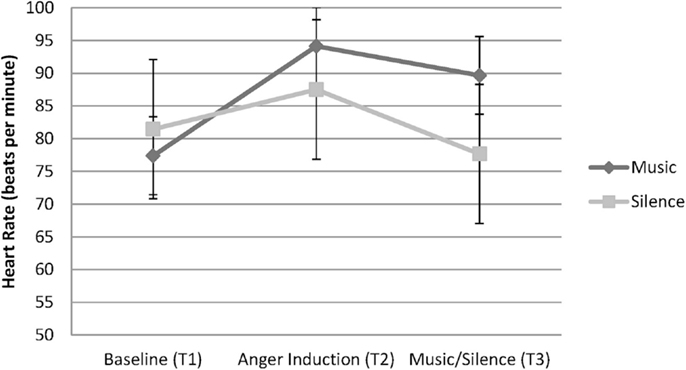
Sharman and Dingle decided to finally test whether extreme music evokes “anger and expressions of anger such as aggression and delinquency,” which had never been backed up by scientific research (1). In their experiment, Sharman and Dingle tested a group of 39 individuals who identified as “extreme music listeners”. The experiment consisted of two parts: an anger “interview”, in which experimenters induced anger in participants, and a period of 10 minutes post-”interview”.
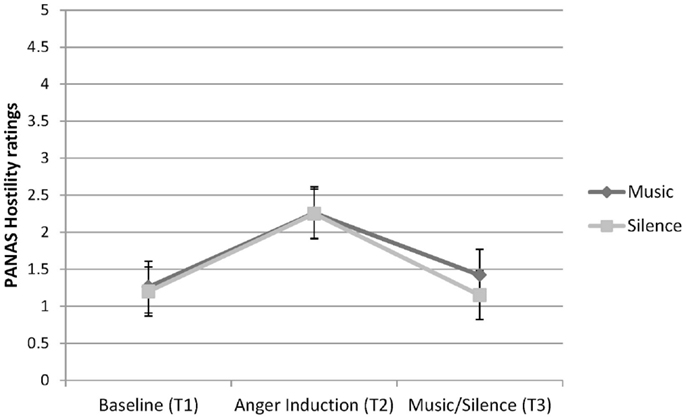
How did researchers induce anger in the participants? Well, anger interviews consisted of the researchers asking the participants to describe one or more events that produced a strong feeling of anger over this period of 10 minutes. Researchers measured anger in two ways: heart rate and subjective participant ratings on what is known as the Positive and Negative Affect Scale (PANAS), which consists of 20 words that describe feelings and emotions (3). Participants rate how they think each item on this list applies to their current mood, on a 5-point scale, ranging from 1 (Very Slightly or Not at All.) to 5 (Extremely).
Thus, the participants’ heart rates were measured, as well as their ratings on PANAS, before the interview, immediately after the interview, and finally again 10 minutes following the interview. Immediately after the anger interview, all participants’ heart rates increased, as well as heightened ratings of “hostility”, “irritability”, and “stress”.

Additionally, after the anger interview, the participants were split up into two groups: one listened to their preferred music for 10 minutes after the anger interview, and the other just sat in silence for 10 minutes. This is where the results begin to differ and get interesting. As would probably be expected, those who sat in silence for 10 minutes had a decrease in their heart rates, and participants from both groups had a decrease in the previously heightened ratings of “hostility”, “irritability”, and “stress”. However, those who listened to their preferred (extreme) music for 10 minutes maintained a heart rate unchanged from the anger interview; The music’s loud sounds seemed to play into the brainstem’s reflex responses, like the startle response, which can be activated by sudden or extreme sounds (cite). As their brainstem reflexes were already activated by the anger interview, the extreme music matched their heightened physiological arousal (e.g. increased heart rate, alertness, etc.). In addition to this, and maybe as a result, the listeners had an increase in positive emotions, such as on the ratings of the words “active” and “inspired” on PANAS, as opposed to no change in the group who remained in silence. Thus, Sharman and Dingle suspect that listening to extreme music “…may represent a healthy way of processing anger for these listeners” (1).
Headbang It Out

We all know how much music can affect us; that’s why we have music we like and that which we don’t. We may have “happy” playlists, “sad” playlists, or even “mad” playlists. However, did you think it could have as much of an effect on you as this research exemplifies? Did you think that extreme music could actually help you process anger, or did you also fall victim to the stereotype that this type of music leads to violent behavior? Well, let us lay that myth to rest, with this research as our evidence to the contrary. Now, the next time you’re super aggravated by someone you love, or frustrated about something that was said to you, just remember what this research tells us: When in doubt, headbang it out.
REFERENCES
- Sharman, L., & Dingle, G. A. (2015). Extreme metal music and anger processing. Frontiers in Human Neuroscience, 9, 272. https://doi.org/10.3389/fnhum.2015.00272
- Juslin, P. N., & Västfjäll, D. (2008). Emotional Responses to Music: The Need to Consider Underlying Mechanisms. Behavioral and Brain Sciences, 31(5), 559–575. https://doi.org/10.1017/S0140525X08005293
- Niemiec, R. M. (2021, February 25). Positive and Negative Affect Schedule (PANAS): Meaning and Use. PositivePsychology.com. Retrieved from https://positivepsychology.com/positive-and-negative-affect-schedule-panas/
 NeuWrite San Diego
Pingback: Nyheder2023juni29-Titler - bionyt.dk