 March
13
March
13
Tags
Into the Mind of the Manatee
The Lazy Life of the Sea Cow

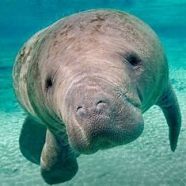
Manatees are the gentle giants of the ocean. Reaching 13 feet long and weighing more than a ton, these mammals should give off a dominating presence, but in reality, the opposite is true [1]. Manatees tend to get along well with most aquatic species. They have no natural predators and are herbivores, consuming 10% of their body weight every day in various aquatic plants and grasses. Their grassy diet and large rounded bodies have earned them the nickname “water cows” or “vegan bodybuilders of the sea.” Likely due to the fact manatees have no natural predators and spend most of their day eating, they tend to lead quite a relaxing lifestyle. When they are not eating, their schedule is filled with sleeping, playing, or simply floating near the surface [2,3]. Due to their couch-potato tendencies, many assume that manatees do not have a lot going on in their minds. It is theorized that they are not only aloof, but perhaps genuinely unintelligent. In fact, evidence for this theory of idiocy goes beyond just their lazy lifestyle. When claiming stupidity, many point towards the physical make-up of the manatee brain. That brings us to a central question: how can a brain look stupid? Let’s take a look, shall we?
Grapefruit Brains
Some researchers think that laid-back manatees may not be the brightest creatures due to the physical composition of their brains. Dating as far back as 1902 with research by biologist Elliott Smith, manatee brains have been perceived as “extraordinary and so bizarre”, presenting as “the brains of idiots” [4]. Harsh as that sounds, on a purely physical level, there are quite a few reasons why Smith may have drawn that conclusion.

When thinking about why the examination of manatee brains led early researchers to classify them as “idiots”, it’s important to step back and look at how information is processed in the brain. The brain is wired by cells called neurons. These neurons form connections to electrically and chemically transmit information throughout the brain. It is through these connections that information about the world is processed, and thoughts and behaviors are generated [5]. A common thought is that the more connections that exist and the less distance the signal needs to travel to get from one connection to the next, the quicker and more varied information can be processed. This increase in neuronal processing can generate increasingly complex thought and behavior [6].

Many consider the outermost layer of the brain called the cerebral cortex to be the driver of intelligence in mammals. As such, it’s important for many animals who rely on larger, complex cortical circuitry that this brain region is given enough space to fit all the cells it needs to function. To accomplish this task, over the course of evolution, many species developed cortical folding, forming sulci (concave grooves) and gyri (convex ridges). Cortical folding creates a more compact structure, allowing for larger surface areas to fit inside one’s skull. These folds give the brain a ‘wrinkly’ appearance. With this perspective on brain structure and cognition, the idea that wrinkles in the brain are associated with complex thought and higher levels of intelligence was formed [7].

In more ways than one, the manatee brain is often compared to a grapefruit. Small. Smooth. Unassuming. To put in comparison, manatees’ grapefruit-sized brains are less than ¼ the size of other large terrestrial or aquatic mammalian brains, putting them on the leaderboard for mammals with the lowest brain-to-body ratios. To top that off, the trademark wrinkles seen in many intelligent mammals, such as humans, primates, and dolphins, are sorely absent in these animals [8]. Lacking either brain size or cortical surface area does not directly signify a less complex neural circuitry, but lacking in both is not a good sign for our friend, the sea cow. Their small, smooth brains decrease the likelihood that manatees can form complex thoughts, driving forward the idea that these gentle giants may not be much more intelligent than the grapefruits their brains resemble.
Defining Intelligence: It’s All About Perspective

However, brain composition and intelligence are not as directly related as many people believe. When looking at the relationship between brain size and intelligence, for instance, no definitive correlation has been found. If larger absolute brains equated to higher intelligence, whales and elephants would outrank humans, and horses would outrank chimpanzees. If you look at brain size relative to body size, the shrew would be the most intelligent mammal on Earth (no one believes this). In addition to brain size, there is no definitive correlation between the number of cortical neurons and intelligence. While humans have the largest sum of cortical neurons, totaling over 15 billion, whales and elephants, who are both perceived to be incredibly smart, have 10-12 billion or fewer cortical neurons and an unusually low neuronal packing density [6].
That leaves us with another question; how do we identify intelligence in animals? Intelligence in other species is typically based on a variety of ill-defined factors. For instance, elephants are considered incredibly intelligent, displaying signs of social awareness, rich emotions, use of tools, and ability to be taught new skills [9]. Many bird species are viewed as intelligent for their apparent ability to understand and mimic human language [10]. Intelligence in dogs is often determined by their ability to understand human language, learn to perform behaviors from human instruction, and their adaptive problem-solving capabilities, such as opening a box, navigating around barriers or getting a treat out of a tube [11]. In contrast, the koala is considered not to be the brightest, having been observed attempting to eat printed pictures of eucalyptus leaves, suggesting they may be unable to distinguish real and artificial objects [12].

Now, let’s look at what these “intelligent” behaviors have in common. Social capabilities, emotional diversity, tool use, understanding human language, learning instructions, problem-solving with man-made puzzles, and ability to distinguish real objects from images of those objects. All these behaviors measure how “human” an animal is. Rather than thinking of an animal’s cognitive needs and abilities within their home environment, these measures look at how similar they are to us in the environments we created. Measuring intelligence based on human standards fails to consider traits and skills that give an evolutionary edge in one species can be vastly different than those of another. When studying social awareness and emotional range, researchers can’t ask animals what they are thinking or feeling. Instead, they look at vocal sounds, behaviors, and body language to gauge animals’ thoughts. However, not all species necessarily present their emotional state in the same ways. The bias of looking for human emotion and behavior in animals may cause researchers to overlook behaviors unique and vital to the species, resulting in false claims of social or emotional incompetence. In addition, tool use is not advantageous to all species, so the inability to wield tools or manipulate objects does not inherently indicate decreased cognition. The inability to problem-solve within an artificial environment may suggest the environment was too different from their natural habitat, rather than a lack of problem-solving skills. Understanding of human language is often determined by an animal’s ability to perform certain behaviors when prompted, which is tightly linked with obedience rather than cognitive capabilities and poses a double standard considering humans’ general inability to understand other species’ communication methods. With all these factors considered, maybe it’s time to look at intelligence in a new light.
Manatee Masterminds

Manatees’ cognition may not appear very complex, and they may not be seen as smart when looking at how “human” they act, but they exhibit intelligence in other ways. When defining intelligence as the ability to integrate themselves into their environment, adapt to changes in their environment, and simply survive, manatees prove to be very bright creatures. Observations of manatees in the wild suggest that they are capable of spatial-based learning, acquiring a mental representation of locations and features of the environment that can be later recalled for navigation and finding resources. This style of learning gives them an evolutionary advantage, allowing them to remember locations that may be advantageous to their survival, such as warm water springs, food sites, fresh water, and navigation routes [13].
The differences between their spatial-based learning and our object-based learning (the result of our evolutionary reliance on tools for survival) become very apparent when looking at the behavior of manatees in rehabilitation facilities. In the facility, manatees were trained to swim through a stationary hoop on command. However, when the hoop was moved, manatees swam to where the hoop was originally positioned rather than through the hoops. While the staff were unable to investigate if this behavior was an anomaly, the results of this training may display manatee learning styles. Manatees in the wild rely greatly on remembering routes and locations and seldom rely on objects the way humans do. Therefore, it’s likely that instead of learning to go through the hoop, they learned to go to the location of the hoop. They were still able to perform the cognitive functions needed to learn, it may simply be that assays reliant on objects may be too foreign to them to properly display their cognitive capabilities [13].
Manatees: Smarter Than Us All?
In conclusion, while manatees may be the couch potatoes of the sea, don’t be fooled, these gentle giants are actually undercover geniuses. While manatees can’t drive cars, read books or do calculus (none of which would be helpful in the deep sea), their navigation skills, spatial memory and ability to become friends with almost any species greatly surpass those of us humans. We can learn a lot from these gentle giants as their small, smooth brains and high intelligence give us a new perspective on how intellect may or may not be represented in the brain. So, the next time you see a manatee, don’t just think “cute,” think “cognitive powerhouse in a wetsuit.” Their bodies may be big, and their brains may be small, but who knows, maybe manatees are smarter than us all.
References
2. https://www.nbcnews.com/id/wbna15655584
3. https://www.nwf.org/Magazines/National-Wildlife/1999/Making-Sense-of-Manatees
4. https://archive.org/details/b28121934_0003/page/n3/mode/1up
5. https://hms.harvard.edu/news/new-field-neuroscience-aims-map-connections-brain
6. https://pmc.ncbi.nlm.nih.gov/articles/PMC4685590/
7. https://www.sciencedirect.com/science/article/pii/S1534580723005804
8. https://onlinelibrary.wiley.com/doi/10.1111/j.1460-9568.2007.05524.x
10. https://www.birdful.org/can-birds-understand-our-language/
11. https://www.akc.org/expert-advice/dog-breeds/smartest-dog-breeds/
12. https://www.planetnatural.com/dumbest-animals/
13. https://www.aquaticmammalsjournal.org/images/49.2_Reep_Bauer.pdf
14. https://spacecoastdaily.com/2015/07/video-manatees-gentle-giants-of-the-sea/
17. https://www.britannica.com/plant/grapefruit
18. https://www.dailypost.co.uk/news/north-wales-news/gallery/sengis-make-debut-chester-zoo-10401295
19. https://wufshanti.com/2015/06/09/amazing-elephant-can-paint-post/
20. https://www.lolaapp.com/suda-painting-elephant/
21. https://manateemigrationandfacts.weebly.com/manatee-migration.html
 NeuWrite San Diego
You must be logged in to post a comment.