
 September
01
September
01
Tags
Mind Over Matter: The Effect of Positive Mindsets on Performance and Well-being
Whether it’s in the form of looking at yourself in the mirror and reading the affirmations on the colorful sticky notes you stuck on the mirror the night before, or taking five minutes during your dreaded commute to work in the morning to think about what you value in life, a positive mindset is an extremely powerful quality to have. Rooted in the interplay between language and cognition, positive affirmations and mindsets have emerged as a compelling avenue for enhancing performance across various domains. While philosophers have postulated the power of affirmations for centuries, modern neuroscience research allows us to delve deeper into the human brain, where thoughts ferment into action.
What is a Mindset?
Many of us have been told “Just be positive”, “You should have a positive mindset”, or “Think more positively”. What does it even mean to have a certain mindset and what is the importance of it? A mindset refers to a mental framework or perspective that selectively organizes and processes information, as defined by Alia Crum, a psychology professor at Stanford who has dedicated her career to the psychology of mindsets (1). Mindsets that we possess allow us to simplify all of the information that we receive from our surroundings and make certain choices. For example, if you perceive intelligent people to be avid readers, you will have the mindset that people who read a lot are intelligent, and therefore choose to read more if intelligence is what you value. Mindsets can include narratives about ourselves that we ingrain into our identity, which can change or affect how we see ourselves. In 2007, a Harvard psychologist demonstrated the immense power of mindsets in a study of 88 hotel maids. Half were informed that the daily tasks that were a part of their jobs constituted vigorous exercise and were educated about their job’s contributions to physical fitness, while the other half received no information. After a month, the group that believed that they had exceeded the surgeon general’s guidelines for fitness exhibited weight loss, reduced blood pressure, and improved body composition despite any alterations to their diet or routine. The uninformed control group didn’t exhibit any of these changes (2). One of the most significant differences between the two groups was what they believed, yet one of the groups was able to manifest physical results. The profound influence of mindsets becomes evident as they shape our perspectives, choices, and even physical outcomes, emphasizing the significance of cultivating a positive mental framework.
Adaptable State of Mind
Our brains are constantly re-molding in response to environmental cues, including how we talk to ourselves, through neural plasticity. Neural plasticity is a fundamental principle that describes the brain’s remarkable ability to reorganize, adapt, and reshape its structure and functional connections in response to experiences, learning, and changes in the environment. It is the brain’s way of flexibly rewiring itself, allowing for the formation of new neural pathways and the modification of existing ones (8). There are two primary types of neural plasticity. Synaptic plasticity involves altering synapse strength between neurons, crucial for learning and memory (9). Synapses are the sites of communication where neurons send signals to each other in which the strength of that signal can be variable to change how strongly the receiving end of one cell responds to the first cell. The other type, structural plasticity, encompasses physical brain changes, including generating neurons, which is significant during early development (9). Neural plasticity plays a crucial role throughout life, from early brain development to adulthood, but it’s more robust early in life from birth to age 25. Neural plasticity allows the brain to adapt to new challenges, recover from injuries, learn new skills, and acquire knowledge. For more Neuwrite articles on neural plasticity and a deeper dive on this phenomenon, follow this link (10). In essence, neural plasticity underscores the brain’s incredible malleability, enabling it to constantly reshape its connections and optimize its functioning based on experiences and demands. How we talk to ourselves or believe about ourselves, whether positive or negative, can mold our brains for better or worse.
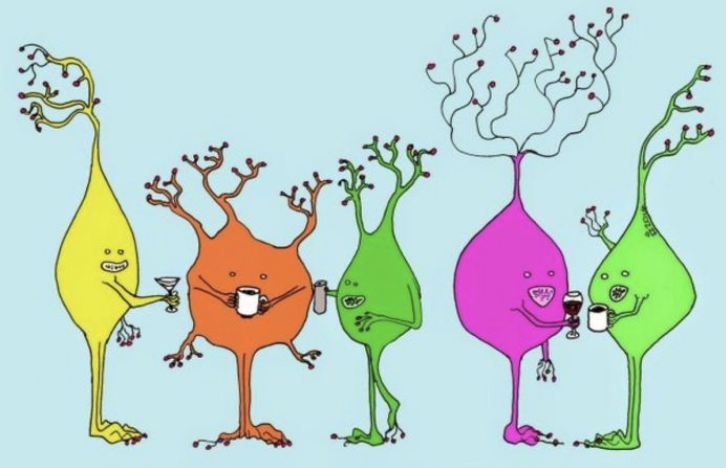
We talk to ourselves and our neurons talk to each other. The Hebbian Theory, proposed by psychologist Donald Hebb in 1949, is a key concept in neuroscience explaining synaptic plasticity’s role in learning and memory (11). It states that if two neurons are active together and consistently participate in joint signaling, the synapse connecting them becomes more efficient, leading to stronger and longer lasting communication. Conversely, if two neurons rarely communicate with each other, their synaptic connection weakens over time (3). This mechanism forms neural networks vital for encoding memories. Hebbian plasticity supports our brain’s adaptability, enabling us to learn, remember, and adjust to new circumstances. This theory supports the idea that consistent positive self-talk promotes the consistent firing of neurons that are active when one harbors a positive mindset, which results in strengthened connections between those neurons and a stronger mental framework. In other words, one can say the more you tell yourself you excel at something, the more your mind and body will act like it.
Positivity is Power
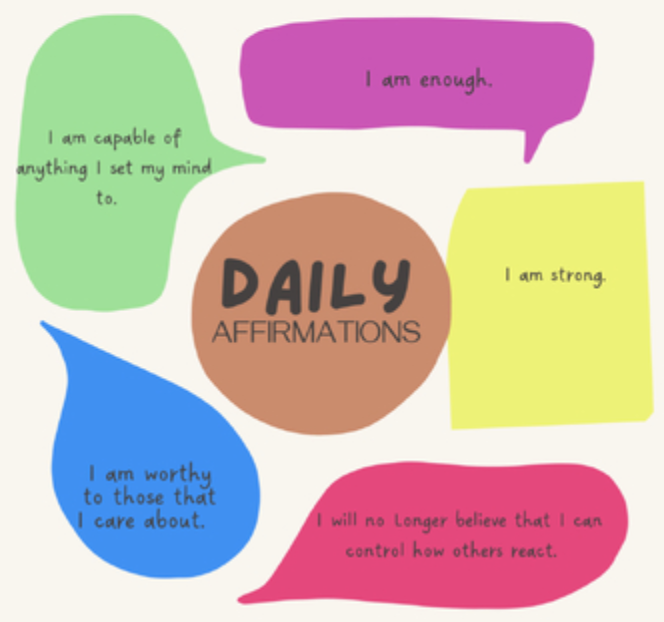
As it turns out, the corny “✨positive vibes only✨” quotes were right. There is a growing body of studies in neuropsychology that demonstrate the power of a positive mindset and self affirmations. Self-affirmations are positive statements that one repeats to themselves in order to improve their confidence and overall well-being. Some examples of self affirmations are “I am strong and capable of growth”, “I am worthy of success in all aspects of life”, and “I am in control of my thoughts and emotions”(12). Saying a couple of self affirmations every morning, for example, is one way that someone could set up or practice a positive mindset. Other ways are by using positive self-talk to promote a supportive internal dialogue with oneself rather than a negative one, practicing meditation, or writing down important values such as education, empathy, or personal growth (13).

One study demonstrates that self-affirmation improves performance on executive functioning tasks (4). They used two types of tasks/puzzles to assess this. The first was the 2-back task in which participants identify whether the current stimulus matches the one presented two steps back in a sequence, often used to assess and study working memory and attention (5). The second was the Stroop task in which participants name the color of words, often conflicting with the actual word’s meaning, designed to assess cognitive control and inhibition. For example, image 3 demonstrates the Stroop task in which participants would have to name out “red, yellow, green, purple, etc.” from top left to top right, instead of “blue, green, yellow, and brown”. This tests inhibition because it challenges one’s restraint of their instinct to read the word as it is instead of saying the color of the word. Prior to the tasks, the participants in the self-affirmed group were asked to write about their most important value, why it’s important to them, and how it affects their attitude and behaviors. Meanwhile, participants in the other group, negatively-affirmed, were asked to write about their least important value and why it would be important to someone else. Their results were that the self-affirmed participants performed better and made fewer errors than negatively-affirmed participants on both tasks (4). This study shows the significant impact of self-affirmation on enhancing cognitive performance, as demonstrated by these improved results and reduced errors in tasks assessing executive functioning, working memory, attention, and cognitive control.
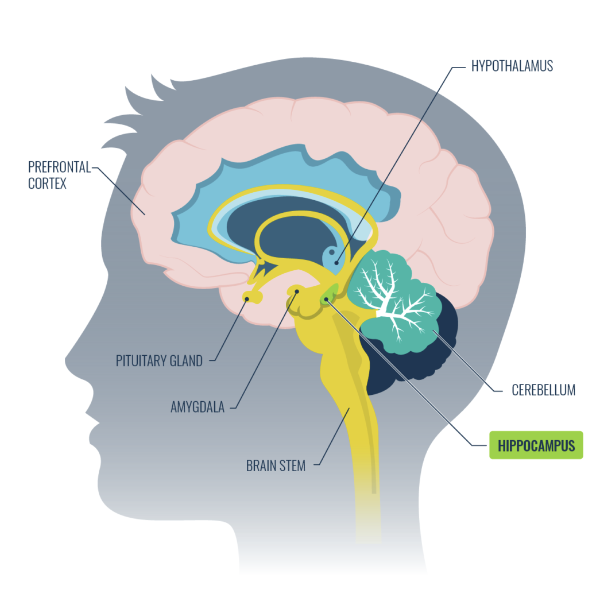
In a two part study by Lang Chen at Stanford University, he shows that a positive attitude towards math supports academic success, both behaviorally and neurocognitively (6). From a behavioral stance, among his sample of 240 children, he discovered that those with positive attitudes towards math had greater mathematical achievement than their counterparts. Subsequently, he and his colleagues embarked upon investigating the specific neural mechanisms that underlie the link between positive attitude and academic accomplishment, an area in which we know limited information about. Their discoveries indicated that positive attitudes correlated with heightened engagement of the hippocampal learning-memory system. The hippocampus is a region of the brain that is the most important memory center, which is why it’s a majorly studied location of Hebbian plasticity and learning (14). The researchers unveiled that when the participants had positive attitudes towards math, their increased performance was connected to two things: they used memory strategies effectively and often and their hippocampus was more active. These two factors seemed to play a role in the relationship between having a positive attitude and achieving higher levels of success in math (6). Lang Chen’s study not only highlights the crucial connection between a positive attitude towards math and academic success but also sheds light on the previously understudied neurocognitive mechanisms, thus contributing valuable insights to the field of positive mindsets and neuroscience.
Mental Health and Well-being
Positive mindsets go far beyond impacting cognitive and academic achievement, and have been proven to impact stress responses as well. Another study conducted at UCLA proved that self-affirmation of personal values buffers neuroendocrine and psychological stress responses (7). This research examined the potential of personal value affirmations to mitigate physiological and psychological reactions to stress. Before engaging in a controlled, stress-inducing challenge, 85 participants were divided into two groups: one group participated in a value affirmation task, while the other did not. The findings indicated that individuals who engaged in value affirmation before the challenge exhibited notably reduced cortisol responses to stress in comparison to the control group. This study is significant because it highlights how much of an impact a positive mindset and self affirmations have on stress responses. About 3 out of 5 adults in both the U.S. and across the global average have claimed that stress has affected their daily lives at least once in the past year (15). Studies and polls like these shed light on the fact that many people suffer from stress and it is a major health problem. The UCLA study underscores the profound significance of positive mindsets, in not only mitigating stress responses but also highlighting the potential for psychological and physiological well-being, offering potential methods for stress management and mental health improvement.
Other areas in which positive mindsets and self affirmations could potentially offer insights to mental health improvement is in cases of depression and anxiety. In a study conducted by Claire Eagleson and others, people with GAD (generalized anxiety disorder) practiced replacing worry with alternatives for one week (16). These alternatives were scenarios of positive outcomes that were shown to them in the form of images or verbal thoughts. The control group rehearsed positive images unrelated to their worries and the other group rehearsed positive images that did relate to their worries. One month later both groups reported significantly reduced anxiety and worry which shows that, unexpectedly, even unrelated positive ideation can effectively counter worry.
Ongoing research in this field will continue to shed light on the incredible power of our thoughts in shaping our brains and behaviors. The potential for applying these findings to improve mental health, alleviate the burdens anxiety and depression, or practice stress management is promising. Although a positive mindset isn’t a cure for anxiety or a hack to ace an exam without studying, it can be implemented as a supplement to increase performance or reduce feelings of anxiety, among many other things. It is clear that the power of a positive mindset extends far beyond mere optimism – it’s an extremely powerful tool, and could be used to reshape our brains and, ultimately, our lives for the better.
References
- “Alia Crum.” Department of Psychology, psychology.stanford.edu/people/alia-crum. Accessed 31 Aug. 2023.
- breathingsmarter, By: “The Harvard Hotel Maid Study: How Mindset Determines Results.” Breathing Smarter, 10 Aug. 2021, breathingsmarter.com/2021/03/23/the-harvard-hotel-maid-study-how-mindset-determines-results/.
- “Hebbian Theory – an Overview | ScienceDirect Topics.” ScienceDirect.Com | Science, Health and Medical Journals, Full Text Articles and Books., https://www.sciencedirect.com/topics/neuroscience/hebbian-theory. Accessed 1 Sept. 2023.
- https://www.sciencedirect.com/science/article/pii/S0022103116302840
- https://www.psytoolkit.org/experiment-library/touch_nback2.html
- https://journals.sagepub.com/doi/10.1177/0956797617735528
- Creswell JD, Welch WT, Taylor SE, Sherman DK, Gruenewald TL, Mann T. Affirmation of personal values buffers neuroendocrine and psychological stress responses. Psychol Sci. 2005 Nov;16(11):846-51. doi: 10.1111/j.1467-9280.2005.01624.x. PMID: 16262767.
- von Bernhardi R, Bernhardi LE, Eugenín J. What Is Neural Plasticity? Adv Exp Med Biol. 2017;1015:1-15. doi: 10.1007/978-3-319-62817-2_1. PMID: 29080018.
- Fauth M, Tetzlaff C. Opposing Effects of Neuronal Activity on Structural Plasticity. Front Neuroanat. 2016 Jun 28;10:75. doi: 10.3389/fnana.2016.00075. PMID: 27445713; PMCID: PMC4923203.
- https://neuwritesd.org/2020/09/17/your-brain-is-plastic/
- https://thedecisionlab.com/reference-guide/neuroscience/hebbian-learning
- https://www.psychologytoday.com/us/blog/click-here-happiness/202204/how-use-self-affirmations
- https://www.mayoclinic.org/healthy-lifestyle/stress-management/in-depth/positive-thinking/art-20043950
- https://qbi.uq.edu.au/brain-basics/memory/where-are-memories-stored
- https://www.ipsos.com/en-us/news-polls/world-mental-health-day-monitor-2022#:~:text=About%203%20in%205%20adults,their%20daily%20lives%20several%20times.
- Eagleson C, Hayes S, Mathews A, Perman G, Hirsch CR. The power of positive thinking: Pathological worry is reduced by thought replacement in Generalized Anxiety Disorder. Behav Res Ther. 2016 Mar;78:13-8. doi: 10.1016/j.brat.2015.12.017. Epub 2016 Jan 8. PMID: 26802793; PMCID: PMC4760272.
 NeuWrite San Diego
You must be logged in to post a comment.