
 June
01
June
01
Tags
Science meets Serenity: Benefits of Sauna Use on the Brain
In the past, I used to laugh when my dad shared that the sauna was his ultimate sanctuary amidst all the gym hustle, and that he would occasionally visit the gym solely for the purpose of using the sauna before promptly leaving. Over the past couple of years, as I began to hear my friends and popular figures increasingly rave about how much they love their gym’s saunas, I realized that my dad was actually a trendsetter. While sweating it out in a small, hot room with a bunch of strangers may not seem like the most appealing activity, the health benefits of saunas are hard to ignore. For years, scientists have been conducting research to unravel the steamy secrets of sauna therapy so that we can learn how to utilize saunas to improve our health and wellbeing.
It’s Getting Hot in Here

The earliest known sauna structures date back 2000 years and were created by the Finnish people. The early Finnish saunas were heated with stone, fire, and occasionally water to create steam. Sauna therapy is considered the cornerstone of Finnish culture, evidenced by the existence of nearly 3 million saunas in Finland today. Heat therapy was, and remains, an integral part of many different cultures that have their own take on heat therapy sanctuaries such as the Roman and Greek bathhouses, the Turkish hammam, and the Korean Jjimjilbang [1]. The modern day sauna is typically heated with electric or infrared heaters. Conventional electric heaters warm the air to 70 to 90°C, and this heat transfers from the air to the body. Infrared heated saunas, on the other hand, emit thermal radiation that heats the body directly at temperatures that range from 45 to 60°C [2].
The reason that saunas have been used for thousands of years and across the world, is because of their profound and proven health benefits. Many general health benefits include lower chances of cardiac arrest and congestive heart failure, lower blood pressure, reduced inflammation, fewer symptoms of depression, increased endurance, increased muscle mass maintenance, and detoxification [2]. As lengthy as this list already is, these are just a handful of the health benefits. Overall, heat exposure has been proven to have phenomenal effects on our bodies, and some of the most fascinating of those effects are the health benefits that heat exposure has on the human brain.
Neuroscience of Saunas
Mental Focus & Attention Span
Saunas and heat exposure have been shown to improve mental focus and attention span through the increase of the hormones norepinephrine and prolactin. Norepinephrine, also referred to as noradrenaline, plays an integral role in enhancing focus and attention and prolactin promotes faster brain function by increasing myelin growth, the material that insulates nerve cells [6].

One study tested 8 healthy young men who were exposed to two conditions of heat in a Finnish sauna bath: 80°C and 100° C. The participants stayed in the sauna only until they experienced mild discomfort. Norepinephrine and prolactin were measured, among other things, and the findings were astounding. Norepinephrine increased about 100% after exposure to the 80°C sauna and 160% after 100°C, and prolactin increased 200% at 80°C and 700% at 100°C [7].
Another very similar study was conducted in women. The norepinephrine and prolactin levels of 11 healthy women were measured before and after exposure to the heat of a Finnish sauna bath. Similarly to the study aforementioned done on men, the findings showed that heat stress significantly increased prolactin and norepinephrine secretion. In the 11 women measured, the percentage increases from the initial concentrations, before heat exposure, of norepinephrine and prolactin varied from 18 to 150% (mean 86%) and from 113 to 1280% (mean 510%), respectively [8]. Although these studies didn’t measure mental attention and focus span directly, the results demonstrating the hormone increases are a great indicator for positive effects on the brain.
Beta-endorphins
Another positive effect of sauna use is the increase of beta-endorphins. Beta-endorphins are neuropeptides, proteins that are produced by neurons, that play a large role in pain management. In the peripheral nervous system, the nerves throughout our body, beta-endorphins attach to receptors on nerve cells which then inhibits the release of pain-promoting substances. In the central nervous system, our brain and spinal cord, beta-endorphins bind to receptors on neurons which results in excess production of dopamine [12]. Beta-endorphins have been said to produce “morphine like effects” and research indicates that they play a role in the “feel-good” response experienced during exercise [2,12]. Who wouldn’t want more beta-endorphins!
There are many studies that prove that heat exposure causes a robust increase in beta-endorphins. In a study by Daniela Jesova and others, participants were exposed to 30 minutes in a 85°C sauna and measurements were taken afterwards to show that the participants’ beta-endorphin levels did increase [13]. Another study tested heat and cold exposure. Similarly, participants were exposed to 90°C heat from a sauna and to a 4°C temperature. Their findings showed that there was an increase in beta-endorphins after the participants used the sauna, but no increase after they were exposed to the cold [14].
Neurogenesis
Another one of the ways that saunas benefit our brains is by promoting neurogenesis. Neurogenesis is exactly what it sounds like: the process of generating or forming neurons. This process is especially important in developing embryos or young babies, but continues to occur throughout a human’s lifespan, as well. Although neurogenesis occurs to a much lesser extent in adulthood, it is still crucial for maintaining optimal brain function [3]. The way that saunas promote neurogenesis is by causing an increase in the expression of brain-derived neurotrophic factors, BDNFs. It is known that heat stress, in the case of sauna use, and exercise are responsible for this increase in expression [4]. BDNFs are proteins that are found in the spinal cord and major areas of the brain, such as the cerebellum, hippocampus, and cortex. These specific areas of the brain regulate learning, memory, mood disorders, and behavior, and BDNFs play an important role in these processes. They also play a large role in promoting the maintenance of existing neurons, the growth of new neurons, and the suppression of neuron cell death [5].
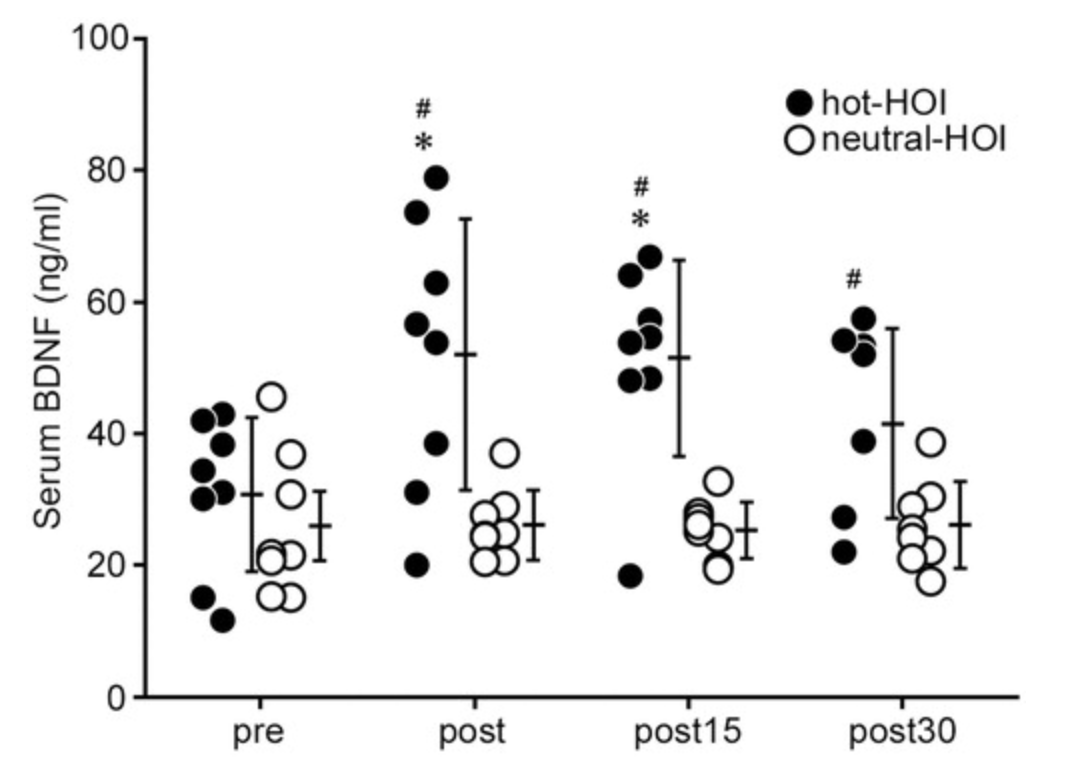
In a study that took place in Japan, participants volunteered to perform a 20 minute head-out water immersion at both 42 °C (hot) and 35°C (neutral). The core body temperatures of the participants in the neutral immersion stayed consistent throughout the entire experiment, while the core body temperatures of the participants in the hot immersion significantly increased during the immersion. After withdrawing and analyzing blood samples, they found that, similarly, BDNFs of the participants in the neutral immersion stayed consistent throughout the entire experiment, while the BDNFs of the participants in the hot immersion showed a significant increase right after the immersion and also returned to baseline 30 minutes after the immersion [4]. These findings demonstrate that the increase of BDNFs are directly correlated to heat exposure.
Depression
Another amazing mental health benefit of saunas is the fact that it has been proven to decrease the severity of depression symptoms. This particular study conducted research on 28 mildly depressed patients with depression symptoms such as fatigue, appetite loss and mental complaints. The patients were assigned to two groups: thermal therapy group and non-thermal therapy group, in which the thermal therapy group patients participated in 15 minutes of sauna use per day and the non-thermal therapy group patients did not. After four weeks, they found that the thermal therapy patients reported less appetite loss and mental complaints than their non-thermal therapy counterparts [9]. These findings demonstrate that thermal exposure in the form of sauna use can diminish symptoms of depression.
Another group of scientists also wanted to test whether or not heat exposure had antidepressant effects. Participants of this study all met the criteria for major depressive disorder and were off of psychotropic medication. The study included two groups of participants, in which one group was subjected to heat exposure through infrared lights that produce heat, and the other group, the control group, was subjected to a placebo condition through lights that do not produce heat. At the end of the 6-week long experiment and intervention, the group of participants who underwent heat exposure reported significantly reduced Hamilton Depression Rating Scale scores and self-reported less severe symptoms than the group of participants who received the placebo treatment [10].
Too Hot to Handle
One of the aspects that all of the studies above have in common, is the direct correlation between their results and an increase in the participants body temperature. This demonstrates that most activities or therapies that significantly raise one’s body temperature, should result in the same positive effects proven in the studies mentioned. Although saunas seem to be the most popular, other beneficial heat therapies include steam rooms, and hydrotherapy such as hot tubs or hot springs.

Another factor that they all have in common is that the sauna trials in the previously mentioned studies all ranged from 15 to 30 minutes. It is important to note that extended periods of exposure to extreme heat can lead to exhaustion, dehydration, and loss of consciousness [11]. However, according to the research, only a relatively short time span of 15 to 30 minutes of heat exposure is needed to experience the amazing benefits.
Saunas and heat exposure have clearly been proven to aid in good health and well-being. With the popularity of sauna use on the rise, there is still more research to be done on how they affect our mental health. Not only can they be relaxing and calming for our minds, but they may be able to help treat serious mental health disorders such as ADHD and depression. The research demonstrating heat exposure’s role in improving mental focus and in reducing depression symptoms have paved the way for more research on how we can use saunas as a tool to alleviate the symptoms of such disorders.
References
[1] Team, Saunas.org. “The History of Saunas.” Saunas.Org, 10 Dec. 2021, saunas.org/the-history-of-saunas/.
[2]“Foundmyfitness” FoundMyFitness, http://www.foundmyfitness.com/topics/sauna#bibid-7f954416abaa1ee08aaf017b714ed659.
[3]“What Is Neurogenesis?” Queensland Brain Institute – University of Queensland, 23 Apr. 2021,qbi.uq.edu.au/brain-basics/brain-physiology/what-neurogenesis
[4] Daisuke Kojima, Takeshi Nakamura, Motohiko Banno, Yasunori Umemoto, Tokio Kinoshita, Yuko Ishida & Fumihiro Tajima (2018) Head-out immersion in hot water increases serum BDNF in healthy males, International Journal of Hyperthermia, 34:6, 834-839, DOI: 10.1080/02656736.2017.1394502
[5]What Is BDNF and How Does It Affect Brain Health? | Thorne, http://www.thorne.com/take-5-daily/article/what-is-bdnf-and-how-does-it-affect-brain-health.
[6]Costanza, Massimo, and Rosetta Pedotti. “Prolactin: Friend or Foe in Central Nervous System Autoimmune Inflammation?” International Journal of Molecular Sciences, 2 Dec. 2016, http://www.ncbi.nlm.nih.gov/pmc/articles/PMC5187826/
[7]https://link.springer.com/article/10.1007/BF0233071
[8] Laatikainen, T., Salminen, K., Kohvakka, A. et al. Response of plasma endorphins, prolactin and catecholamines in women to intense heat in a sauna. Europ. J. Appl. Physiol. 57, 98–102 (1988). https://doi.org/10.1007/BF00691246
[9]Masuda, Akinori MD, PhD; Nakazato, Masamitsu MD, PhD; Kihara, Takashi MD, PhD; Minagoe, Shinichi MD, PhD; Tei, Chuwa MD, PhD. Repeated Thermal Therapy Diminishes Appetite Loss and Subjective Complaints in Mildly Depressed Patients. Psychosomatic Medicine 67(4):p 643-647, July 2005. | DOI: 10.1097/01.psy.0000171812.67767.8f
[10]Janssen CW, Lowry CA, Mehl MR, et al. Whole-Body Hyperthermia for the Treatment of Major Depressive Disorder: A Randomized Clinical Trial. JAMA Psychiatry. 2016;73(8):789–795. doi:10.1001/jamapsychiatry.2016.1031
[11] Benefits and Risks of Sauna Bathing – the American Journal of Medicine, http://www.amjmed.com/article/S0002-9343(00)00671-9/fulltext. Accessed 1 June 2023.
[12]Sprouse-Blum AS, Smith G, Sugai D, Parsa FD. Understanding endorphins and their importance in pain management. Hawaii Med J. 2010 Mar;69(3):70-1. PMID: 20397507; PMCID: PMC3104618.
[13] Ježová, Daniela, et al. “Rise in Plasma β-Endorphin and ACTH in Response to Hyperthermia in Sauna.” Hormone and Metabolic Research, 14 Mar. 2008, http://www.thieme-connect.de/products/ejournals/abstract/10.1055/s-2007-1013648. %5B14%5D Plasma ACTH, Beta‐endorphin, Prolactin, Growth … – Wiley Online Library, onlinelibrary.wiley.com/doi/abs/10.1002/smi.2460080310. Accessed 1 June 2023.
 NeuWrite San Diego
You must be logged in to post a comment.