
 May
15
May
15
Tags
The glymphatic system and neurodegeneration: a carwash for your brain
If you’ve been keeping up with hot topics in neuroscience research, you may have recently started hearing buzz about the glymphatic system. This topic has been making waves in the fields of sleep and neurodegeneration research. Although we are learning new things about the brain every day, many of its major functions and critical pathways have been understood for many decades. Considering this timescale, it is remarkable that the discovery of the glymphatic system was first published in 2012 [1, 2].
But first, the lymphatic system
The researchers who discovered the glymphatic system asked a simple question – how does the brain clear out unwanted molecules that begin to build up in its circulation? For the rest of the body, we rely on our lymphatic system to perform this task. The lymphatic system works in cooperation with our circulatory and immune systems to ensure that fluid is properly circulated throughout the body. Ultimately, it returns the byproducts from circulating blood plasma, called lymph, into specialized lymphatic vessels which eventually allow it to reenter the bloodstream. Lymph is filtered through lymph nodes, which act as a crucial checkpoint before eventually returning to the blood. In the lymph node, damaged cellular contents are removed, and local immune cells work to fight any bacterial or otherwise harmful contents picked up from the body’s periphery during circulation [3]. Though you may only know the location of a few lymph nodes, there are actually hundreds of them in the human body, and they are working constantly to fight potentially harmful agents [4]. Thus, while we understand how our periphery is well-protected, it begged the question of how the brain may achieve this feat. The first clue was to further investigate the liquid that cushions and hydrates our brains: cerebrospinal fluid (CSF). CSF circulates around and through our brains, helping to circulate nutrients and even cushion the brain in instances of head injury. It also plays an important role in flushing out waste that shows up in circulation, like damaged cells and unnecessary proteins [5]. However, this is a passive process, meaning it is quite slow and is not necessarily proportionate to the brain’s needs. Thus, researchers asked if there may be a secondary, active method of clearing out debris via the CSF.
The Brainwash
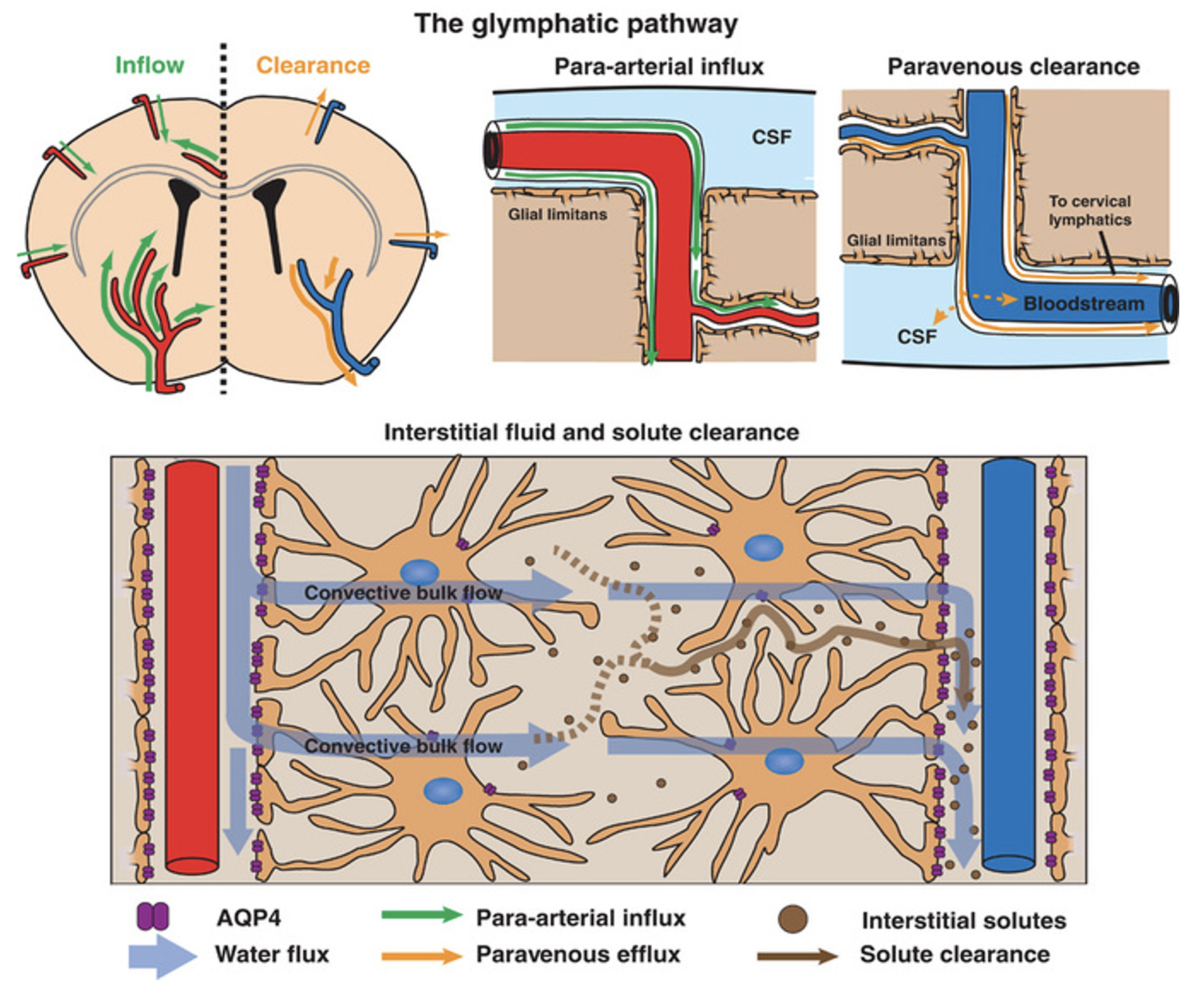
To assess the pathway followed by CSF, researchers infused fluorescent tracers into the CSF of anesthetized lab mice. Initially, the dyed CSF travelled alongside arteries (para-arterial), making its way across the brain and washing over many neurons. Ultimately, they found that the dye travelled from arteries to veins, where it once again travelled in parallel to these circulatory structures (paravenous) and eventually exited the brain. As it washed over brain tissue, the CSF collected built-up proteins and other particles (the brown objects depicted in Figure 1), bringing them on the journey out of the brain. This system is supported by non neuronal cells in the brain known as glia, specifically a type known as astrocytes. It was discovered that astrocytes must express a water channel known as aquaporin-4 (AQP4) to create the necessary flow of CSF across brain tissue to collect aggregated waste. This flow from these channels is active rather than passive. This means it works to push the CSF across a gradient from artery to vein, creating a much faster flow to facilitate collection of the junk along its pathway. Thus, astrocytes and AQP4 were revealed as key players in moving CSF swiftly to collect and quickly evacuate debris. You can think of AQP4 as a conveyor track in a carwash, moving the car through the wash cycle and popping it safely out the other side. Without proper AQP4 function, the car would idle in the midst of the carwash, and that pesky bird poop would remain stuck on your windshield instead of being washed away safely. Ultimately, researchers dubbed this system the glymphatic system, due to its similarity to the lymphatic system and its reliance on glia [2].
If you are interested in hearing the scientists who worked on this study describing their findings, it is available here:
Sleeping on brain health
With the discovery of this fast-paced, ongoing method for cleaning debris from the brain, researchers put its function to the test with one of the most notorious proteins in the field of neurodegeneration – amyloid-β. Amyloid-β aggregates are one of the major hallmarks of Alzheimer’s disease (AD), the most prevalent type of dementia [6]. These aggregates form structures called plaques and eventually lead to synaptic issues – deficits in neurons’ ability to send signals to each other. In the original glymphatic system study, they inquired if this system may be involved in preventing the buildup of detrimental proteins such as amyloid-β. To study this, they infused a large volume of a fluorescently labelled amyloid-β compound. Staggeringly, deletion of the gene responsible for the expression of AQP4 led to a ~55% decrease in clearance of amyloid-β, compared to control mice with normal Aqp4 gene expression. This demonstrated a very important role for the glymphatic system in maintaining a healthy brain and preventing the buildup of potentially devastating amyloid-β plaques.

With what we now understand about how the glymphatic system works, it begs the question: how can I keep my glymphatic system happy and healthy? The answer may be simpler than you think. One of the most effective ways to give your glymphatic system a chance to clear AD related buildup from the brain is to get good sleep! Surprisingly, there already exists a vast body of evidence which indicates that poor sleep and short sleep duration are associated with both increased risk for AD, and amyloid-β and tau (another common aggregate in AD) buildup and pathology [7]. In accordance, rodent studies also indicated that sleep deprivation decreased glymphatic function [7]. During sleep, the brain undergoes shifts in expression of naturally occurring chemicals that keep it active during wakeful times. One of such chemicals is the neurotransmitter norepinephrine. When norepinephrine levels naturally decline at night, the cells in our brain change form and become more compact, increasing the space outside our neurons where CSF can flow with lowered resistance [8]. This phenomenon is partially to thank for the efficacy of the glymphatic system during slumber.While there is not yet a definitive, causal link between poor sleep and neurodegeneration, this evidence may be enough to encourage one to put their phone down early and get a full eight hours of sleep each night. If not, a closer look at the glymphatic system of AD patients just might do the trick. Recent studies are able to assess plasma biomarkers (biological signatures) for AD pathology in a non-invasive manner, allowing for a better understanding of the amount of amyloid-β and tau, even before clinical symptoms appear. These methods were employed in a large recent sleep study, where healthy participants were subjected either to normal sleep or sleep deprivation in a well-controlled laboratory setting to measure the experience’s effect of glymphatic drainage and clearing of amyloid-β and tau. They discovered that many physiological sleep factors were associated with higher levels of glymphatic function (measured via biomarker output) compared to sleep deprived trials, particularly during NREM (non-rapid eye movement) sleep. This phase of sleep is generally thought of as the most calm and restorative phase [9, 10]. Tragically, more elderly individuals do not spend as much time in deep NREM sleep, and sleep quality naturally declines with age [9].
Keeping the carwash running
Each year, each month, each week – it feels as if we learn more about the way our bodies work. Exploring healthy aging and learning new ways to stay sharp will always be an interest of humankind, and through science communication we hope to convey these exciting findings. Unfortunately, part of this process is also debunking pseudoscience. Sadly, many ‘hacks’ for stimulating both the glymphatic system and the body’s lymphatic system are largely exaggerated and inconsequential. While massages to stimulate lymphatic drainage can be effective for dysfunctioning lymphatic systems, it may not do much for someone with a typically functioning lymphatic system, as some sources may claim [11]. Similarly, there is no easy way to kickstart your glymphatic system via massage. While certainly not negative, there is no hard evidence yet to show that it makes a difference, as research is currently limited to preclinical work in animal models, as well as a selection of case studies [12]. However, as aforementioned, the greatest thing you can do to ensure a happy glymphatic system is get good quality sleep – and if a massage relaxes you and helps you get better sleep, then that is certainly worth something.
Citations
- Scientists discover previously unknown cleansing system in brain. (2012). Retrieved from https://www.urmc.rochester.edu/news/story/scientists-discover-previously-unknown-cleansing-system-in-brain
- Iliff, J. J., Wang, M., Liao, Y., Plogg, B. A., Peng, W., Gundersen, G. A., … Nedergaard, M. (2012). A paravascular pathway facilitates CSF flow through the brain parenchyma and the clearance of interstitial solutes, including amyloid β. Science Translational Medicine, 4(147). doi:10.1126/scitranslmed.3003748
- What does the Lymphatic System Do? Learn its function & how it works. (2025). Retrieved from https://my.clevelandclinic.org/health/body/21199-lymphatic-system
- What are lymph nodes? (2026a). Retrieved from https://my.clevelandclinic.org/health/body/23131-lymph-nodes
- What is cerebrospinal fluid (CSF)? (2026b). Retrieved from https://my.clevelandclinic.org/health/body/csf-cerebrospinal-fluid
- Abdulkhaliq, A. A., Kim, B., Almoghrabi, Y. M., Khan, J., Ajoolabady, A., Ren, J., … Pratico, D. (2026). Amyloid-β and tau in alzheimer’s disease: Pathogenesis, mechanisms, and Interplay. Cell Death & Disease, 17(1). doi:10.1038/s41419-025-08186-8
- Dagum, P., Elbert, D.L., Giovangrandi, L. et al. (2026). The glymphatic system clears amyloid beta and tau from brain to plasma in humans. Nature Communications 17, 715. https://doi.org/10.1038/s41467-026-68374-8
- Plog, B. A., & Nedergaard, M. (2018). The glymphatic system in central nervous system health and disease: Past, present, and future. Annual Review of Pathology: Mechanisms of Disease, 13(1), 379–394. doi:10.1146/annurev-pathol-051217-111018
- Nedergaard, M., & Goldman, S. A. (2020). Glymphatic failure as a final common pathway to dementia. Science (New York, N.Y.), 370(6512), 50–56. https://doi.org/10.1126/science.abb8739
- Sleep. (2023). Retrieved from https://my.clevelandclinic.org/health/body/12148-sleep-basics
- Lymphatic drainage massage – separating fact from fiction. (2026). Retrieved from https://www.uclahealth.org/news/article/lymphatic-drainage-massage-separating-fact-fiction
- Bartlett, M. J., Erickson, R. P., Frye, J., Doyle, K. P., Pires, P. W., & Witte, M. H. (2025). Manual lymph drainage massage of the head and neck improves cognition and reduces pathological biomarkers in the 5x-FAD mouse model of Alzheimers disease. bioRxiv : the preprint server for biology, 2025.08.08.669361. https://doi.org/10.1101/2025.08.08.669361
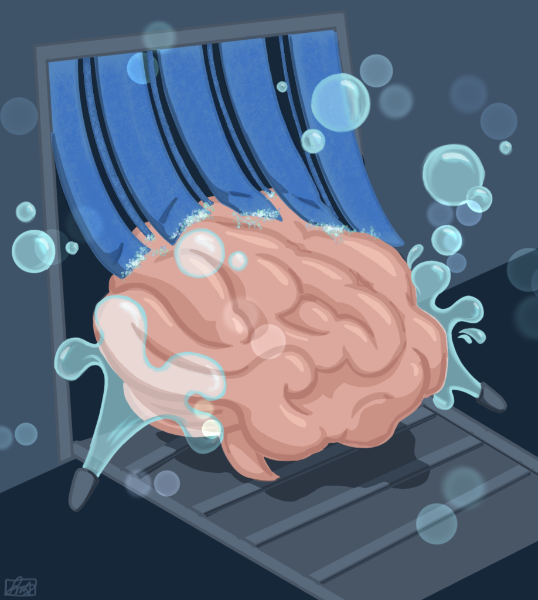
Cover illustration created by Jay Mosko, @biomaterialart


You must be logged in to post a comment.