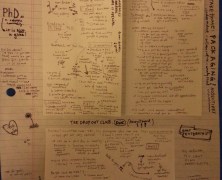
This week, I had the pleasure of joining several UCSD Biomedical Sciences grad students and a few other Neuro grad students in a BMS-run career development course. Over the course of 4 afternoons, I practiced the art of note-taking to add to my skill set and to prepare a tip sheet for you! Note: Your […]
Category Archives: Neuroscience
 May
25
May
25
Fly Eyes!
posted by UCSDNeuro
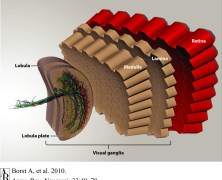
Imagine what it would feel like to be a fly, with most of your head covered in eyes, allowing you to see in pretty much any direction. That’s exactly what Axel Borst studies: motion vision in the fruit fly (Drosophila melanogaster), one of the most widely studied species of fly. The behavioral model that has […]
 May
06
May
06
Dissecting circuits: Bridging the gap from circuits to behavior
posted by UCSDNeuro
Chalasani S.H., Chronis N., Tsunozaki M., Gray J.M., Ramot D., Goodman M.B. & Bargmann C.I. (2007). Dissecting a circuit for olfactory behaviour in Caenorhabditis elegans, Nature, 450 (7166) 63-70. DOI: 10.1038/nature06292
 April
29
April
29
Functional Compartmentalization and Viewpoint Generalization Within the Macaque Face-Processing System
posted by UCSDNeuro
One thing humans, and in fact all primates can do with remarkable ease compared to computers is face recognition, especially across a range of viewing conditions. At her lab at Caltech, Doris Tsao tries to explore the way the brain does this. In her recent Science paper, she explored view invariance in the recently discovered […]
 April
15
April
15
Vision is complex: Predicting responses despite non-linearity and heterogeneity
posted by UCSDNeuro
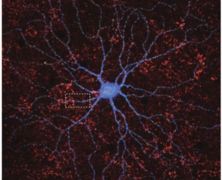
What does it mean to understand vision? Can we know how the retina will react when we see our favorite painting or our best friend before it even happens? The work of Dr. Fred Rieke hopes to do just that. Not unsurprisingly, vision is complex and studying it is hard. The output neurons of the […]
 April
07
April
07
Wave makers: The origins of corticothalamic slow oscillations
posted by Emilie Reas
It might come as a surprise that while you’re asleep or at rest your neurons do not enjoy a similar period of tranquil inactivity, but instead remain hard at work. In fact, previous studies report that coordinated waves of slow oscillatory activity (< 1 Hz) spread through the cortex and thalamus during sleep, waking rest […]
 March
30
March
30
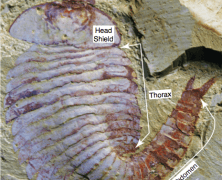
Arthropods: More than just a pretty face, they have brains that can preserve for over half a billion years
posted by UCSDNeuro
Behold the Arthropods. They are invertebrates with exoskeletons, segmented bodies and jointed appendages (examples: insects, arachnids, crustaceans). Exquisitely versatile and adaptable, they comprise the most species-rich phylum and they’ve been around since at least the early Cambrian Period (541-485.4 million years ago, (Mya)). Look where you’re standing. Chances are that an athropod’s already been there […]
Carla Shatz: An Inspiration for Women in Neuroscience
posted by kkiritah
Dr. Carla Shatz is a woman of many firsts. She began her career in neuroscience as the first undergraduate student of Drs. David Hubel and Torsten Wiesel of Harvard Medical School (yes, that Hubel and Wiesel who won the Nobel Prize for their work on the visual system in 1981). After graduating from Radcliffe College […]
Primate Visual Space: The Entorhinal Frontier
posted by UCSDNeuro
Throughout the course of human history, great metaphorical emphasis has been placed on developing an understanding of our “place in the world.” Although this proverbial construct refers more to a sense of self-efficacy, it underscores the inarguable importance of determining our position as it relates to the environment around us in producing proper behavior. Research into the neural mechanisms […]
A brave foray into the daunting complexity of the human cortex
posted by UCSDNeuro
Understanding the organization of human cortex has proven to be more difficult than examining that of other animals. For instance, we are more limited in the methods we can use to investigate human cortical networks. Brodmann attempted to classify and name human cerebral cortex by studying the cytoarchitecture of post-mortem brains; his legacy was a […]
 NeuWrite San Diego
You must be logged in to post a comment.